National Highway Freight Program
National Highway Freight Program Funding
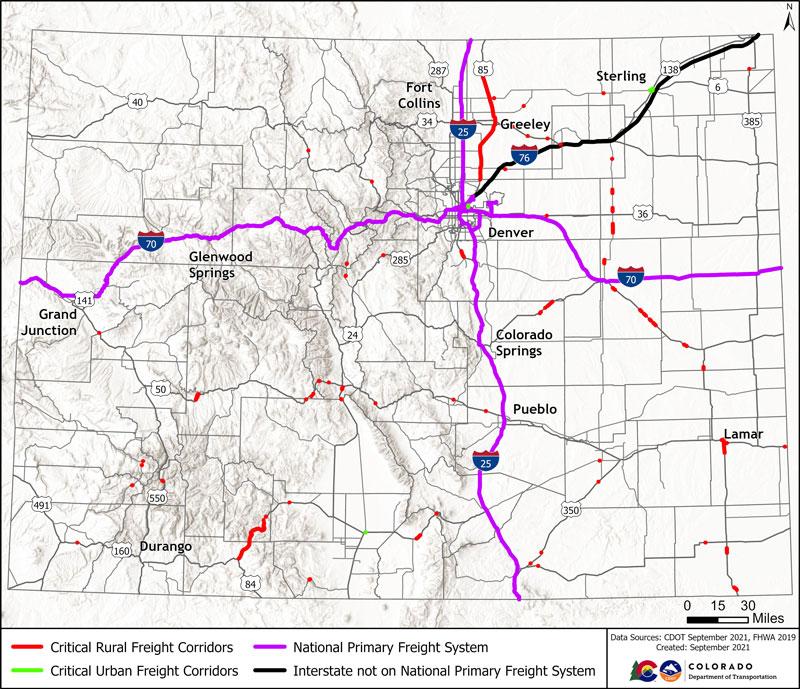
The federally-funded National Highway Freight Program (NHFP) is a formula-based funding program that supports investments in the National Highway Freight Network (NHFN) across the U.S. Projects funded through the NHFP contribute to efficient goods movement on the NHFN.
Priority Alignment
CDOT is guided by the Colorado Freight Plan evidence, literature and studies and stakeholder input. Those critical pieces of information are combined to develop prioritization criteria to determine strategic NHFP investments. Projects focus on Colorado freight system investments, such as:
Improve Mobility & Efficiency of Goods Movement
Enhance Safety & Security for Commercial Carriers
Improve Sustainability & Reduce Environmental Impacts
Planning for a Healthy Transportation System
Funded Projects
Funded projects address critical urban, suburban and rural freight infrastructure improvements. Shared through the Freight Investment Plan, projects are distributed across Colorado to ensure the investment maintains a statewide reach.
In additional to a statewide reach, the funds strategically target two goals:
- 1. Improving Mobility & Sustainability
Three of the top 100 most heavily congested highway freight bottlenecks in the country are along highways in the Denver area. The Colorado Motor Carriers, the Colorado Advanced Manufacturing Alliance, the Colorado Office of Economic Development as well as private businesses and public stakeholders acknowledge that congestion and physical constraints placed on goods movement both increase costs for businesses and consumers, and increase unnecessary greenhouse gas emissions.
CDOT is currently working partners and mobility data sources to identify congested pinch points and bottlenecks in highway, intermodal, and rail systems that hinder goods movement. High frequency bottleneck locations, or the identified top capacity constraint locations, will be prioritized for potential projects. Mobility data includes truck volumes, network criticality, costs and potential benefits and other performance measures.
- 2. Enhancing Safety
CDOT is currently assessing statewide crash data to identify patterns and specific commercial vehicle hotspot locations. This data driven analysis results in the identification of specific project opportunities to make commercial vehicle travel safer.
Potential NHFP projects are assessed based on safety-related performance measures, including overall truck volume, crash severity, crash hotspot recurrence, and other project level measures.